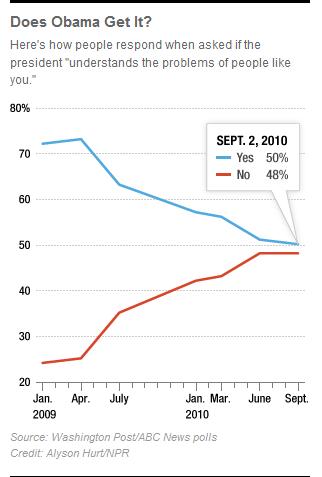
Here's how people respond when asked if the president "understands the problems of people like you."
Washington Post-ABC News poll results
Source: Washington Post/ABC News polls
Credit: Alyson Hurt/NPR
According to polls conducted by The Washington Post and ABC, the percentage of Americans who believe that Obama "understands the problems of people like you" has dropped from about three-fourths at the start of his presidency to just half today.
"This is the place where the heart and outward manner work against one another," Wayne says. "In terms of helping people who need help the most, Obama is far more sympathetic and has done more than either Bush. Yet George W. Bush conveyed an averageness about him that Obama does not."
The Beer Primary
Bush was the prime beneficiary of a theoretical question: Which candidate would you rather have a beer with? In both 2000 and 2004, Bush was up against Democratic candidates — Al Gore and John Kerry, respectively — who came across, or at least were described, as being aloof or wooden.
By contrast, Wayne says, even when Obama hosted his "beer summit" at the White House, it looked more like "a formal tea."
Bush's winning personality represented a turnaround from the failings of his father. George H.W. Bush enjoyed approval ratings of 89 percent at the end of the first Gulf War in 1991, yet he carried just 37 percent of the popular vote a year later against Bill Clinton.
President George H.W. Bush (right) pushes the keys on a new high-technology cash register in 1992.
Barry Thumma/AP
President George H.W. Bush (right) pushes the keys on a new high-technology cash register under the watchful eyes of Leo Hardy (left) and Bob Graham during a visit to the National Grocers Association trade show on Feb. 4, 1992, in Orlando, Fla. Media accounts portrayed the president as being "amazed."
With the economy struggling, the elder Bush came across as distant — notably in a widely reported incident in which he was apparently unfamiliar with supermarket scanners. Clinton, by contrast, seemed to carry as his personal motto the phrase, "I feel your pain."
"The person doesn’t change," George C. Edwards III, a presidential scholar at Texas A&M University, says of George H.W. Bush. "His personality doesn't change at all, but we saw it in a different light."
The Likability Factor
There's sometimes a gulf between the personality people convey on the national stage and how they act in more intimate settings. Gore has been widely described as likable and funny in social situations, yet appeared stiff as a candidate. By contrast, even many of Ronald Reagan's closest advisers say they never really connected with him on a personal level, but optimism and warmth were very much part of his public persona.
Reagan conveyed a folksy personality through stories, as well as through photographs taken of him relaxing over drinks with Democratic House Speaker Thomas "Tip" O'Neill of Massachusetts. "Even when his poll numbers were low, he came across as a powerful figure," says Fred I. Greenstein, a professor of politics at Princeton University and author of a recent book on presidential leadership styles.
President Reagan speaks at a campaign rally in Mesquite, Texas, on Nov. 5, 1988.
Jerome Delay/AFP
President Reagan connected to voters with a folksy image. Here, he speaks at a campaign rally in Mesquite, Texas, on Nov. 5, 1988.
But personality is not wholly determinative of poll ratings. As Wayne, the Georgetown professor, points out, George W. Bush retained his agreeable personality as the Iraq war went sour, but he ended up hugely unpopular nonetheless. Clinton, by contrast, was not trusted or personally admired during much of his second term, but his approval ratings remained high as he presided over a time of peace and prosperity.
"People didn't think highly of him — they thought he was a scoundrel," Edwards says. "Only a third of the public approved of Bill Clinton as an individual, but two-thirds approved of his performance as president."
Show Some Emotion
Millions of Americans liked and even loved Obama as a candidate in 2008. "We greeted this president with such high expectations," says Karlyn Bowman, a polling expert at the American Enterprise Institute. "We liked what we saw about him initially, and if people didn't feel the connection with him, they did with his family."
But Obama has not managed to remain in "campaign mode," especially when talking about policy, Greenstein says. While oil continued to spill into the Gulf of Mexico throughout the spring, many commentators noted Obama's lack of visible anger.
President Obama shakes hands after speaking at the annual Milwaukee Area Labor Council Laborfest.
Politics
Obama Tries To Convince Voters He Feels Their Pain
Asked in June by Larry King on CNN whether he was angry at BP, Obama said, "I think it is important to underscore that I would love to just spend a lot of my time venting and yelling at people. But that's not the job I was hired to do."
White House aides grew frustrated at media demands that the president shout from the rooftops or wear less formal clothes to the Gulf shore. "The media has decided to home in on one issue above all others — presidential emotion," Fareed Zakaria commented on his CNN foreign affairs program GPS in June. "Have we all gone crazy? What purpose would be served by having the president scream or cry?"
But the fact that Obama doesn't sound angry when he says he's angry, Wayne says, "has created a gulf between people who want to empathize with the president — and, more important, want the president to emphasize with them in their difficulties."
Obama's Self-Containment Policy
There are plenty of observers who think that the way a president's personality comes across on television matters a lot less than his accomplishments. "It's not clear to me that this is the key to any kind of success," says Edwards.
Still, a president who doesn't appear easily upset at a time of war and economic retrenchment is naturally going to have some difficulty connecting with the average American. And Stanley A. Renshon, a City University of New York political scientist and psychoanalyst who has written several books about presidential personalities, says that qualms about Obama's rational, analytical style may speak to a deeper ambivalence toward him that is apparent among a share of the public.
Obama fashioned his own self-contained personality out of a childhood that was marked by absent parents. He instilled in himself an enormous confidence that has brought him quite far, Renshon notes.
But that confidence has also led him to become a "conviction president," Renshon says, with a marked willingness to chart his own course against the tides of public opinion, as with the health care expansion.
"When the public feels like they're being ignored, pointedly and consciously, there's a visceral response to that," Renshon argues. "Worse than not listening is the idea that he doesn't care. He does what he thinks is right and has a lot of confidence in that, and full steam ahead."
---