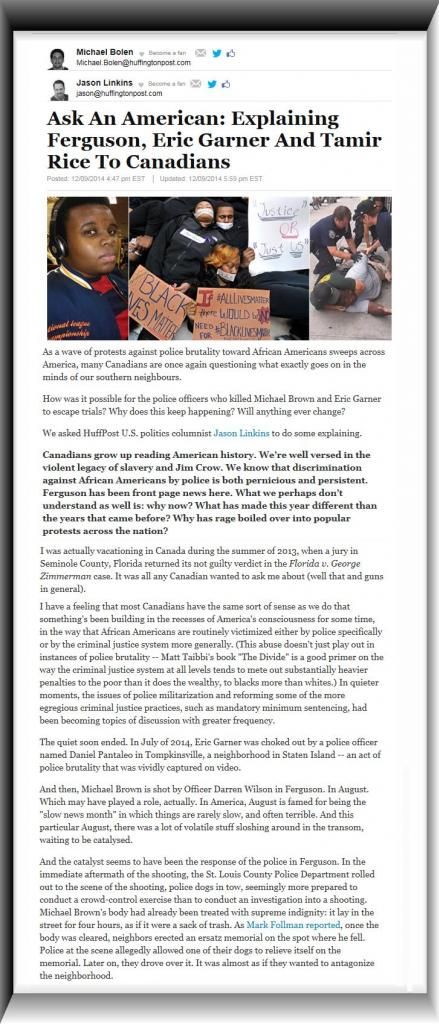
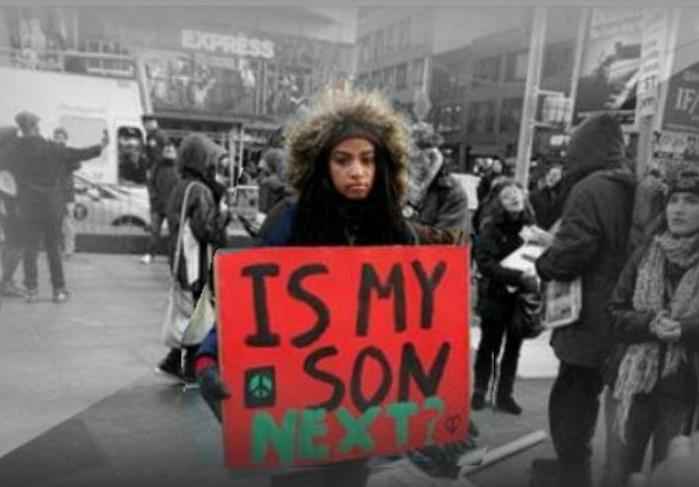
Tamir Rice,
Michael Brown & Eric Garner Protests, Canadians Ask,
NOTHING NEW, WHY NOW?
Who better to ask about the injustices in
our Nation than someone who lives outside of it? This
article “Ask
An American: Explaining Ferguson, Eric Garner And Tamir
Rice To Canadians” has come along at a
time when much of the America psyche has either slightly
questioned or is in total agreement that cops should not
be held responsible for their crimes (even if it’s
subliminal at the moment). Inspirited protests that will
soon be seen as superfluous in a matter of days and
eventually wind up as a blip on most people’s minds
with the names Timor Rice, Eric Warner and Michael Brown
eventually getting lumped together to become one
ubiquitous question; Who?
I get overly excited about protests against
injustice; (Remember
the 99 percent-ers) always ‘sort of’
believing that maybe this time they will work and things
will change. Yeah right, then after just a short time,
watching them fade away, returning America to business as
usual with personalities that should be laughed at,
getting elected to the highest governmental posts. But,
in spite of my pessimistic nature, I still hold a pinch
of faith that perhaps this time it will be different and
injustice will become a fluke rather than a status quo.
Hmmm, I wonder how long this interlude of my strict
belief in Murphy’s Law, will last.
(Murphy's
Law is an adage or epigram that is typically stated as:
Anything that can go wrong, will go wrong.)
EXCERPT: The officers
who killed Eric Garner and Michael Brown won’t
be charged because of grand jury rulings. Canada got
rid of its last grand juries 30 years ago. They seem
open to serious manipulation by prosecutors. Why are
they still around and is there any way to get rid of
them?
Grand juries play roles both symbolic and practical
in the criminal justice system. All of which are
arguably vestigial. From a practical standpoint the
grand jury proceedings allow a prosecutor to lock
down sworn testimony from witnesses (to guard against
their stories changing), and make a test run of the
case in front of a jury pool. Symbolically, the grand
jury is supposed to be a guard against prosecutorial
misconduct -- ordinary citizens essentially vet the
case and, in theory, this is supposed to guard
against a rogue prosecution. Additionally, America's
governing bureaucracies at all levels tend to allow
"activity" to pass for
"achievement." Grand juries are supposed to
serve as proof that the justice department is
working. After all, prosecutors are out there,
getting indictments!
If you've read Thomas Wolfe's book "The Bonfire
Of The Vanities," then you have probably
encountered the saying, "A good prosecutor could
indict a ham sandwich." The phrase is attributed
to a judge named Sol Wachtler, who learned this the
hard way when he was himself indicted for extortion.
The Huffington Post's Sam Stein recently hosted an
edition of his "Drinking And Talking"
roundtable series about the Michael Brown/Eric Garner
cases, in which two of his guests -- civil rights
attorney Donald Temple and civil attorney Doug Sparks
-- discuss the results of the grand juries in both
cases. I recommend readers check it out, but their
salient point is that a grand jury will do whatever a
prosecutor leads them to do. It would appear in the
Ferguson case that the prosecutor, Bob McCulloch,
simply did not want to indict a cop. So the evidence
was presented in a way that favored Wilson's point of
view. Typically, a prosecutor just uses the grand
jury to determine whether there is probable cause --
a reason to have a trial. I don't think the evidence
in Michael Brown's case necessarily made for a
slam-dunk prosecution of Wilson. Still, I would have
preferred to have a trial sort all of that out.
McCulloch's behavior was pretty unusual for a
prosecutor. In the tedious, twenty-minute oration
that he gave when releasing the grand jury's
decision, McCulloch made it clear that to his mind,
it was simply ridiculous that anyone even asked for
an investigation into the killing of Michael Brown.
To McCulloch, Brown's death was simply the natural
order of the universe, and questioning that was
inconceivable. He made that point, over and over
again, along the way blaming the national press and
"social media" for essentially perverting
what he saw as the natural order of things. The grand
jury, McCulloch said, "gave up their lives"
to render a decision in this case -- clearly he
thought the entire matter wasn't worth even a moment
of skepticism, and those who humored the skeptics
made great sacrifices.
But prosecutors of all stripes have a fairly cozy
relationship with the police. This is somewhat
understandable -- the police help prosecutors make
cases, after all. But what happens when the suspect
is a cop? A grave imbalance, as it turns out: as
Trevor Timm, making the case for reforming the grand
jury system in The Guardian, notes: "If you are
an ordinary citizen being investigated for a crime by
an American grand jury, there is a 99.993% chance
you’ll be indicted. Yet if you’re a police
officer, that chance falls to effectively nil."
Will we get reform? I think it will be discussed in
some circles, and reforms will be proposed, and then
those reforms will quietly die on the vine. ~~~
For the last generation the Republican Party has
branded itself as the "law and order
party," but the recent libertarian strain in the
conservative caucus is forcing a re-think of
supporting police and prosecutors unquestioningly.
There is a possibility that Senators like Ted Cruz
(R-Texas) and Rand Paul (R-Ky.), and Representatives
like Raul Labrador (R-Idaho) can help create
bipartisan reforms to the criminal justice system
that would change the way non-violent drug offenders
are sentenced, ending the practice of mandatory
minimum sentences. It's not like Eric Garner's death
had a lot to do with these things that we are close
to reforming -- but sympathy for a man unjustly
killed could nevertheless inspire a heroic act of
legislation. Or, nothing will happen, because
conservative legislators won't want Obama to get
"credit" for signing a legacy-boosting
sentencing reform bill into law. (There's that zero-sum thinking
again!)
But look, you have really come to the wrong person if
you want optimism. It wasn't long ago that the
shocking video of James Foley's death at the hands of
ISIS inspired the nation to once again get its war
on. These days, I'm still watching execution videos
-- but the killers aren't people who flamboyantly
cast themselves as the enemies of our way of life.
Rather, they are the police we assign to protect it.
And these cops demonstrate a similar level of
brutality, and an equal lack of remorse, in and for
their actions. What's lacking is the effort to really
do something about it. I don't expect that to change.
I recently read a blog post from the mother of a
mixed-race family -- her two sons, Owen and Kyle,
were adopted from Haiti. () Two days before
Thanksgiving, she wrote, "Today, we are dealing
with the Ferguson decision. It is another sad, sad
day for mamas of black boys. Deeply demoralized and
shaking scared, we keep on fiercely loving them, and
wait and hope for the world to see them as we
do." This is a rare instance of a white mother
who is able to empathize -- not merely sympathize,
empathize -- with the fear that African-American
women who raise sons and daughters (but especially
sons!) live with every day. Fostering empathy is
brutally impossible work, I recommend her piece as a
tool in at least doing the necessary
thought-exercises. I fear, however, she has much
longer to wait. As do we all.